
THE DAIRY COOPERATIVE
An insurance policy against livestock mortality
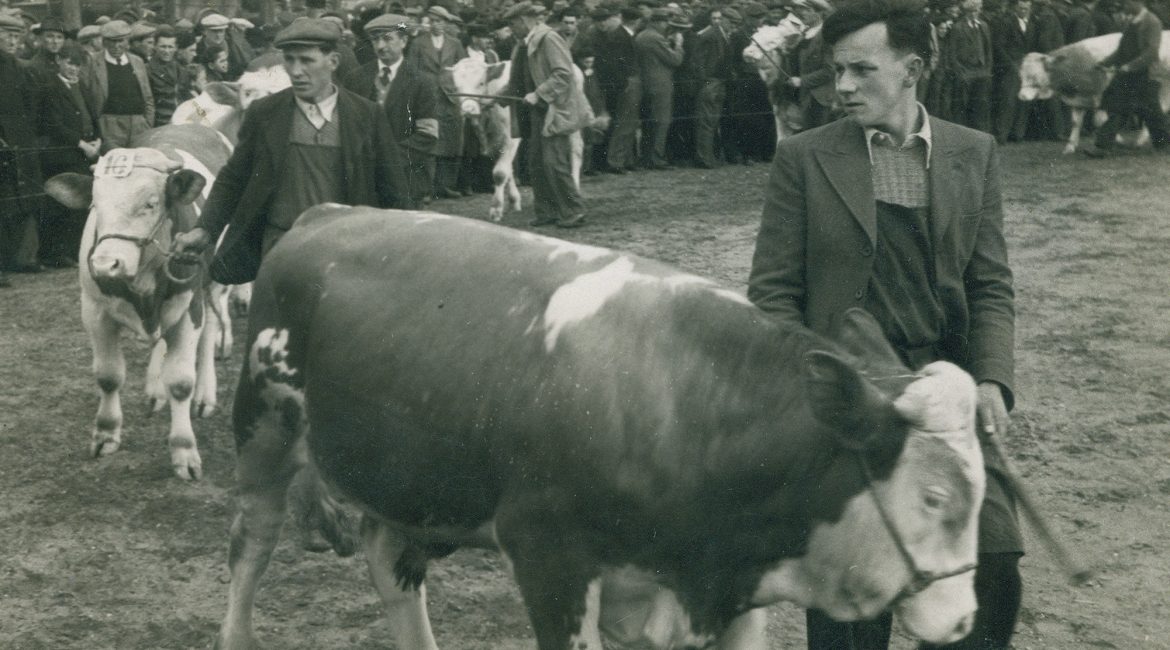
From the end of the 19th century until 1950, cattle farmers paid into a mutual insurance scheme to receive compensation for livestock mortality. During this period, the size of the herds increased considerably. The number of cattle increased from 976 in 1955 to 1,531 twenty years later.
A favourable environment for the creation of a dairy cooperative
At the end of the Second World War, the quantities of milk produced were much lower than those produced before the war: in 1938, total production was 2,408 hectolitres compared to 1,507 hectolitres at the end of hostilities.
In 1960, artificial insemination, the selection of breeders, rational animal feeding, and the establishment of study and advisory bodies contributed to a constant increase in milk production. From 3,000 litres per year and per cow in 1950, it rose to more than 8,000 litres in 1960.
It was against this background that on Monday 4 March 1957 the Coopérative Laitière de Hoerdt (Hoerdt Dairy Cooperative) was created. In 1959, the municipality leased the cooperative a plot of land behind the former town hall (now the library) for 30 years to build a milk collection centre.
Milk quota policy
In the mid-1950s, sterilized milk first appeared on the market. For small pasteurized milk producers, this was a worry. The major dairy companies were accused of trying to wipe them out, especially as they did not have the financial capacity to install a sterilization line.
The problem of overproduction became a critical issue with long-life milk. Producers were forced to sell their milk at lower and lower prices. From the 1970s to the 1980s, the “dairy” plans the European authorities drafted to reduce production came thick and fast without much success.
Since 1984, there has been a milk quota system in place in the European Union. This was the rather particular context in which the Coopérative Alsace Lait (Alsace Dairy Cooperative) was created, bringing together the dairy cooperatives of Strasbourg, Haguenau, Berstett, Molsheim and Riedseltz.
In 1986, Alsace Lait built its new site in Hoerdt.
The following year, the municipal council decided to acquire the buildings of the Coopérative La Tour in order to build the new town hall there.