
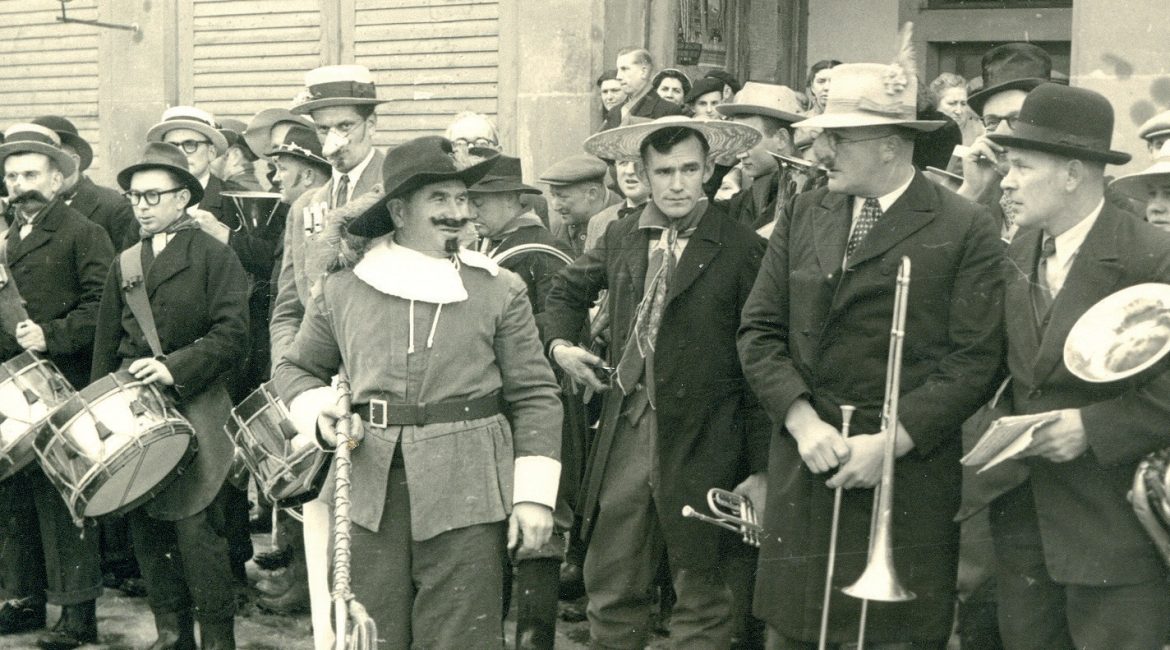
Many music groups are also part of the parade
THE CARNIVAL
A very old tradition
Throughout Europe, various festivals and folklore events take place in January and February to reach their peak on Mardi Gras (Shrove Tuesday). During this period, Alsace brings to life a wide range of popular customs.
Well established in the Christian liturgical calendar, the Carnival period begins on the Day of the Kings (Epiphany) and ends on the first day of Lent (Ash Wednesday). This period is reserved for recreation. Mardi Gras (literally meaning “Fat Tuesday”) is a day when the Catholic Church allows its faithful to eat meat before the period of fasting during Lent. The excesses of Carnival are reminiscent of the pagan traditions of the Roman and German popular festivals, which commemorated the return of spring with banquets, dances, parades and costumes.
Hoerdt’s carnival procession
The first carnival procession in Hoerdt can be dated back to 1925. In 1936, the Carnival had its moment of glory thanks to a highly acclaimed float, the “Normandy liner”.
The Hoerdt Carnival then experienced some difficulties before finding a new start after the Second World War. A first parade was set up spontaneously in 1950 on the initiative of a group of friends, and the following year gave rise to a proper organization. About thirty horse-drawn floats and many groups participated in it.
The organizers, under the leadership of René Maechling, were called the Committee of Madmen – the Nàrre
committee. The name of the Carnival of the Lords – Herrefasenàcht – was used from the first year, the parade taking place on Tuesday, as opposed to the Carnival of the Peasants – Bürefàsenàcht – which took place on the following Sunday.
On the evening of Rose Monday (the Monday before Mardi Gras), the people of Hoerdt usually met at one of their houses to celebrate Sperrnocht, before disguising themselves to go around the restaurants.
In October 1996, the Fasenàchts Nàrre announced their intention to organize the next procession on the Sunday before Mardi Gras. The financial risks seemed too great to them if the event took place outside school holidays. There was even talk of having no more parades… It was against this background that a new
carnival association was created on René Wolfhugel’s initiative in order to prevent a tradition from disappearing : the Hoerdt Herrefasenacht Carnival Association.
Since then, the number of floats has generally ranged from 40 to 60, with a record high in 1998 when more than 80 floats were on parade. These were all produced by private individuals.
The success was immense: during the school holidays, nearly 20 000 people attended the festivities. Many other events accompanied the procession: the Costumed Ball, the Seniors’ Carnival, the Miss Carnival pageant, the Children’s Carnival and the Rose Monday Ball.