

ASPARAGUS GROWING | A FAVOURABLE SOIL
Sandy soil
The Zorn River, which was still a meandering waterway in the past, had a high volume of water in the spring that caused large floods. Long before the construction of dikes, this phenomenon was the origin of the soil composition of the fields to the south and west of the village : the sand that had been torn from the sandstone of the Northern Vosges mixed with the earth and formed the silt, a sandy soil.
The local soil has thus become an ideal soil for growing asparagus. This requires well-drained, slightly sticky soil, which has been extensively loosened and cleared of perennial weeds.
Distinctive mounds
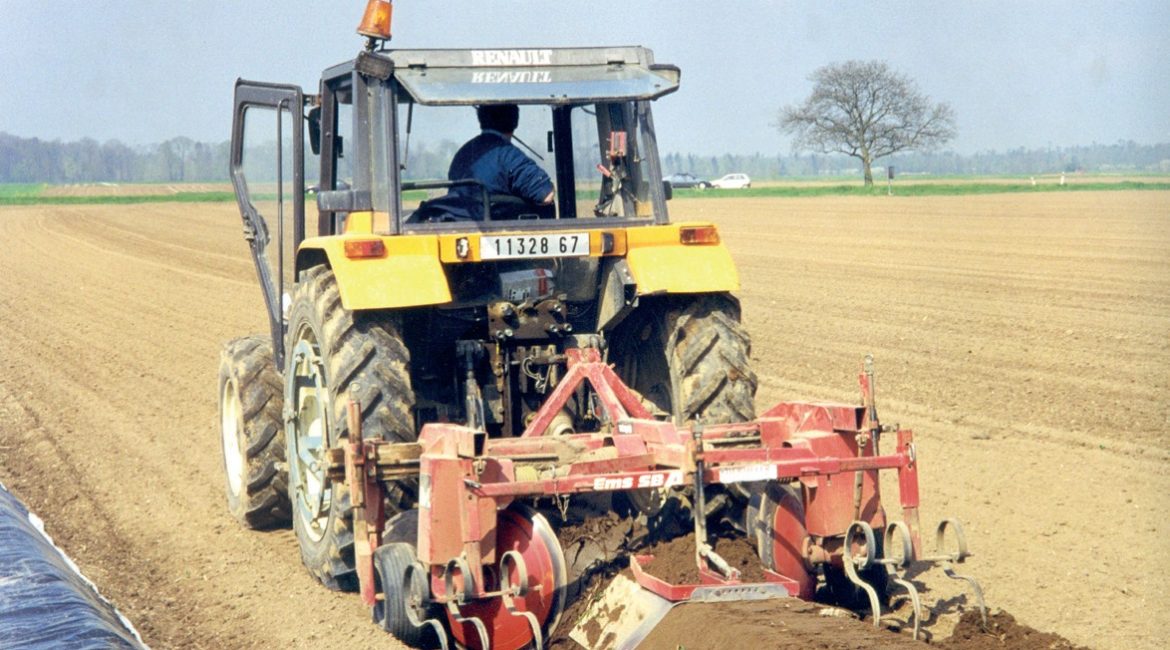
In the past, farmers used to form individual mounds of earth – Spàrichelhiffe – with a hoe, after having prepared the soil. These mounds allowed the best possible exposure to the sun, helping to warm up the soil and to harvest the asparagus early.
This way of growing asparagus in “mounds“ gave Hoerdt a distinctive and particularly recognizable agricultural landscape.
The space between the asparagus claws, that is, the entire root system, was 1 m to 1.20 m to leave room for the rhizomes to expand over the years.
Nowadays, to improve yield, more productive hybrid claws are planted every 25 centimetres. As a result, the life span of asparagus plantations is shorter than in the past (15 years compared to 8 years today).